
 The South Carolina Commission on Higher Education recently concluded a multi-phase training initiative to strengthen how colleges and universities support service members and veterans across the state through the evaluation and awarding of academic credit based on military learning experiences and training.
The training initiative, “Connecting Service, Credit, and Collaboration to Strengthen Pathways for Military Learners in South Carolina,” was created in partnership with the South Carolina Department of Veterans Affairs to align best practices and translate national frameworks into practical, campus-level solutions that improve student outcomes. More than 80 professionals from a range of functional areas completed this year’s training, representing public and independent institutions across the state as well as the South Carolina Technical College System.
“From a statewide perspective, advancing credit for prior learning is both an educational priority and an economic imperative,” said CHE President and Executive Director L. Jeffrey Perez, Ph.D. “Ensuring that military learners can effectively translate their experience into academic credit supports their individual success while strengthening South Carolina’s workforce and long-term competitiveness.”
Valuing experience, removing barriers
South Carolina is home to more than 33,000 active-duty service members, with thousands of military-connected students pursuing postsecondary education each year. Institutions across South Carolina already serve significant numbers of these students: for example, the University of South Carolina enrolls approximately 2,300 military-affiliated students while Clemson University supports more than 1,200 through dedicated engagement programs.
Service members and veterans face unique challenges related to credit mobility, credit transfer, and navigation through higher education pathways. Retired Army Command Sgt. Maj. Jelani Edwards, now the Midlands regional integration officer for the South Carolina Department of Veteran Affairs, spoke to these challenges as plenary speaker at the in-person session.
“Every year, transitioning service members and veterans enter South Carolina with leadership experience, technical expertise, discipline and a ‘mission first’ mindset. But when they walk onto a college campus, too many of them are told (directly or indirectly) to start over, and that doesn't just cost time. That costs them confidence, momentum and financial resources. And in some cases, they believe that higher education is not even worth it,” Edwards said.
“Military credit for prior learning is a formal recognition of skills, knowledge and competencies that service members gain through their military training, education and operational experience, and the translation of that experience into academic credit that will help accelerate their degree plan,” Edwards said. “If we streamline systems and processes for veterans to succeed from a higher learning perspective, they will want to stay here. If we value their experience, they will invest in our communities. If we create clear pathways, they will strengthen our workforce.”
Program structure and statewide model
The training was designed as a scalable professional development model that combines self-paced learning, institutional collaboration, and in-person engagement. Rather than relying on a single workshop or event, the program was structured in phases that allowed participants to build foundational knowledge, consider the application of concepts on their own campuses, and connect with peers.
The initial online phase of five micro courses opened on March 6. Phase two was an in-person kickoff event April 17 in Columbia that included regional breakout sessions, a student panel and a lunch and learn guest panel as well as opportunities to network and share information informally.
What participants gained through the program
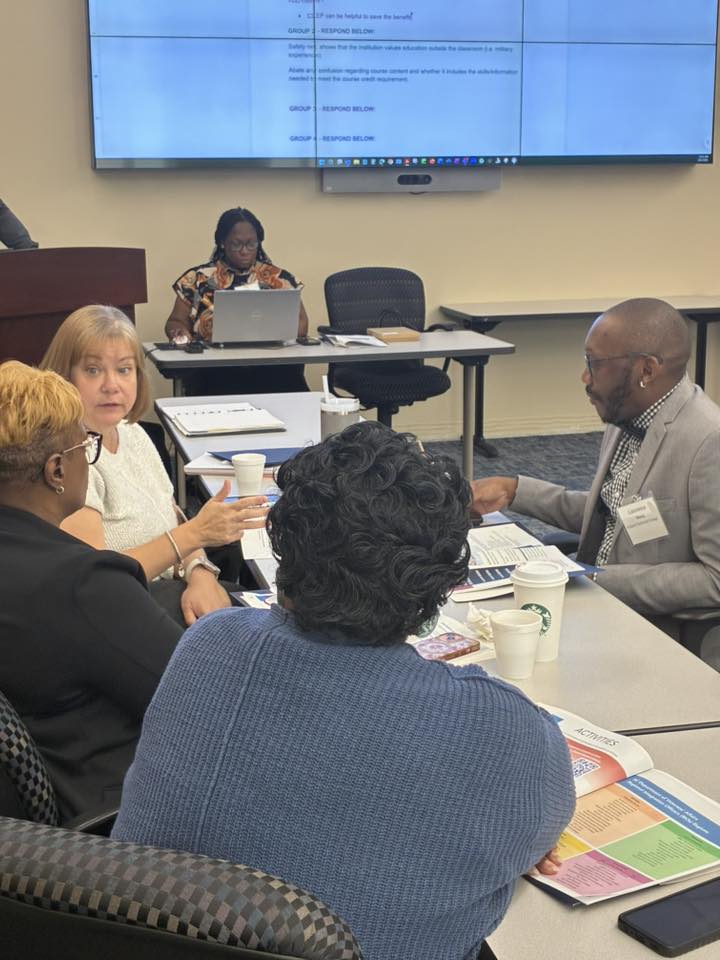 Detailed instruction explored how military training and experience can translate into college-level outcomes, how to use national resources such as the American Council on Education (ACE) Military Guide and ACE Engage platform, and how to evaluate military transcripts more consistently. The program also highlighted strategies to align military learning with degree pathways, reduce excess credits and costs, improve time to degree, and strengthen campus processes across advising, admissions, registrar, and transfer functions.
Participants who completed the online phase received an Advocate Certificate of Participation, while participants who completed both online and in person phases received at a Champion Certificate of Participation.
The training is part of CHE’s broader efforts to connect higher education with South Carolina’s workforce and economic priorities. By convening institutional military support professionals through the SC Military Credit for Prior Learning (SC M-CPL) Advisory Board, CHE aims to reduce duplication of effort across institutions and accelerate the adoption of proven strategies that support completion and workforce alignment.
This is CHE’s second training focusing on military credit mobility in recent years. In 2025 the agency partnered with American Council on Education Learning Evaluations for a four-phase training program that also included both in-person and online elements.
Through this program and other credit mobility efforts, CHE is helping build a more responsive and efficient higher education system—one that recognizes the contributions of those who serve and strives to give them clear pathways to degrees, credentials, and careers.